
Dizi Construction and Acoustics: The Science of Bamboo, Edge Tone, and Membrane Resonance
Explore the dizi's bamboo construction, hole layout, edge-tone acoustics, and membrane resonance, with listening tips.
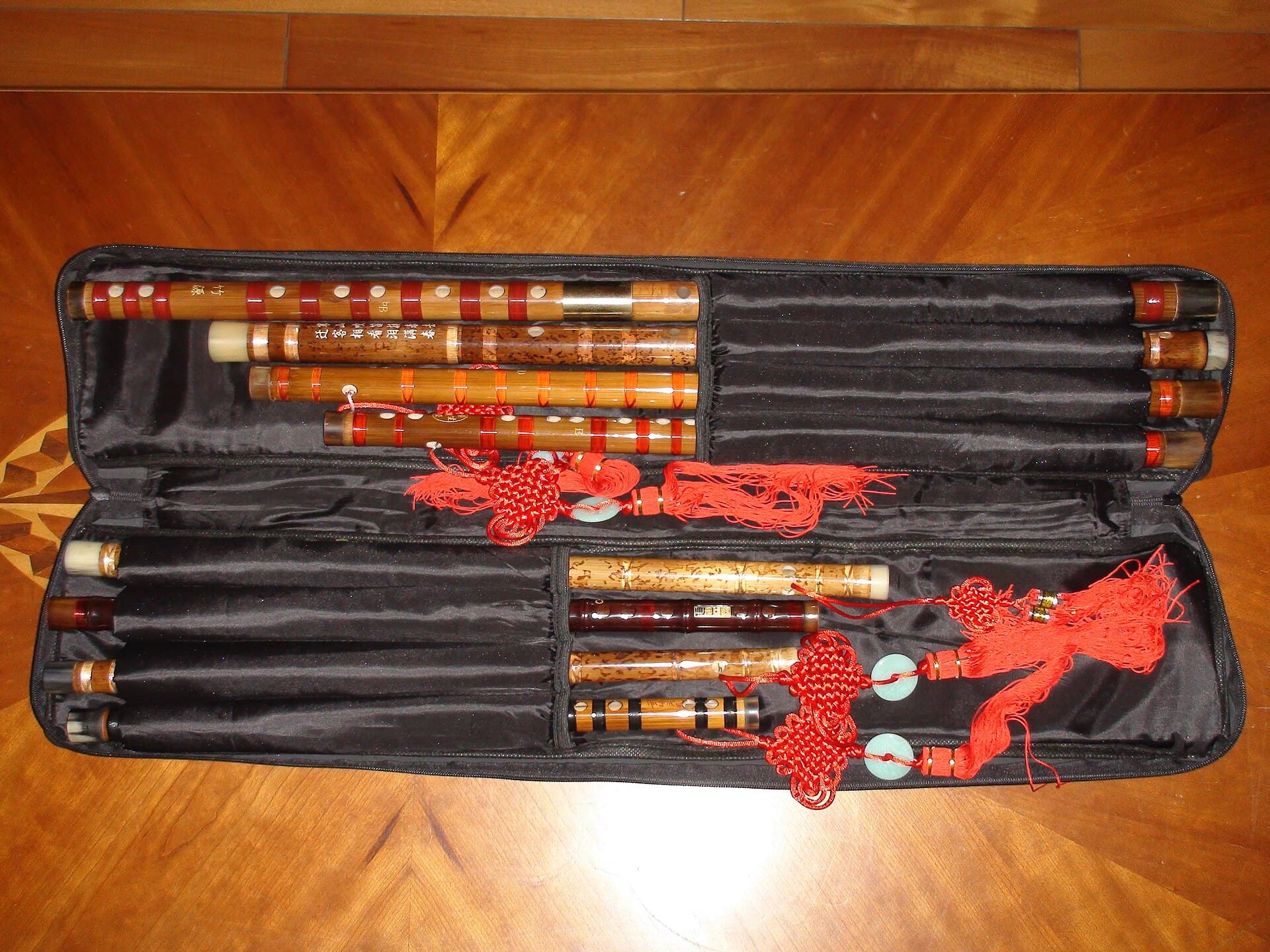
1. Bamboo Tube and Finger Holes: The Basic Framework
The dizi is essentially a hollow bamboo tube, usually made of bitter bamboo (ku zhu) or purple bamboo (zi zhu), with recent variants using mottled bamboo, wood, or jade. The bamboo's density, fiber orientation, and inner smoothness directly affect timbre: bitter bamboo, with thick, solid walls, yields a bright sound, while purple bamboo, with fine grain, produces a softer tone. The tube features a blow hole, a membrane hole, six finger holes (on the traditional six-hole dizi), and several tuning/vent holes. Finger holes were originally equidistant; later, to facilitate semitones, the spacing between the two right-hand holes was increased and that between the left and middle pairs decreased, resulting in today's non-uniform layout. The positions and sizes of the blow and membrane holes have been empirically refined over generations to optimize airflow angle.
2. Edge Tone: How Airflow Becomes Sound
The dizi's sound production hinges on the edge-tone effect. The rim of the blow hole is shaped into a sharp edge at a specific angle, and the player directs an air stream across it. The air splits at the edge: part exits the tube, part enters. This splitting induces periodic vibrations in the air column, with frequency determined by airflow speed, blow-hole dimensions, and edge angle. The player controls pitch and timbre by adjusting embouchure—lip shape, airflow angle, and pressure: faster air yields higher frequency, slower air lower. The edge-tone effect allows the dizi to sound without a reed and gives it flexible pitch control, underpinning techniques like portamento (hua yin) and vibrato (rou yin).
3. Air Column and Resonance: Determinants of Pitch
Air entering the tube travels in a spiral until it exits at the far end. Along the way, the air column resonates at frequencies determined by the tube's diameter and effective length. Effective length is set by the combination of open and closed finger holes: with all holes closed, the air column is longest and the pitch lowest; opening holes successively shortens the column and raises the pitch. Bore diameter affects timbre and volume: bangdi (northern dizi) with a narrower bore sounds bright and high, while qudi (southern dizi) with a wider bore sounds mellow and round. The positions of the blow and membrane holes also help tune resonance characteristics, maintaining relatively even response across registers.
4. Dimo: The Membrane That Adds Crispness
The dimo is a thin membrane glued over the membrane hole. Traditionally made of bamboo membrane or gut membrane, it is now usually made from reed membrane, which combines the crispness of bamboo membrane with the durability of gut membrane and is less prone to tearing, making it the common choice. Excited by the airflow, the membrane vibrates sympathetically, adding a distinctive “membrane buzz”—a crisp, slightly rustling color. Membrane tension can be adjusted during application: tighter membrane yields a brighter tone, looser membrane a softer one. The dimo distinguishes the dizi from the membrane-less xindi and is a key source of its timbral identity.
5. From Construction to Listening: How to Hear the Dizi Today
With an understanding of construction and acoustics, listening can focus on several layers. First, notice the attack shaped by the edge-tone effect: each note's onset often carries a slight “breath sound” as the air strikes the edge—a characteristic sense of respiration. Second, pay attention to membrane vibration: in forceful passages or the high register, the membrane buzz becomes more pronounced, creating a shimmering texture. Third, distinguish how the structural differences between bangdi and qudi translate into sound: the bangdi's shorter, narrower tube yields a bright, high tone suited to lively northern styles; the qudi's longer, wider tube produces a mellow, round tone suited to gentle southern styles. Fourth, observe how the player uses embouchure changes to control pitch and timbre, especially in portamento and vibrato, where the edge-tone effect's flexibility shines. There is no need to seek a specific recording; instead, compare how different players handle membrane buzz and breath sound in the same piece.
Questions
What material is best for the dizi membrane?
Reed membrane is most common; it combines the crispness of bamboo membrane with the toughness of gut membrane, resists tearing, and yields a bright, stable tone. Bamboo membrane is crisp but fragile; gut membrane is tougher but less crisp. Choose a membrane that is even, thin, and translucent.
Why is the dizi's blow hole shaped with a slanted edge?
The slanted edge splits the airflow at a specific angle, sending part into the tube and part outside, thus exciting the air column. This angle has been empirically optimized to improve sound production efficiency and allow flexible pitch and timbre control through embouchure.
What are the main construction differences between bangdi and qudi?
The bangdi has a shorter tube and narrower bore, producing a bright, high pitch; the qudi has a longer tube and wider bore, producing a mellow, round pitch. Both share the same finger-hole layout principle, but size differences directly affect the air column's effective length and resonance, resulting in distinct timbres and ranges.
Source: 笛子