
Liuqin Construction and Acoustics: From Hollowed Willow to Penetrating High Notes
The liuqin is the high-pitched plucked instrument of the Chinese orchestra. This article explores its construction and acoustics, explaining how body, strings, frets, and
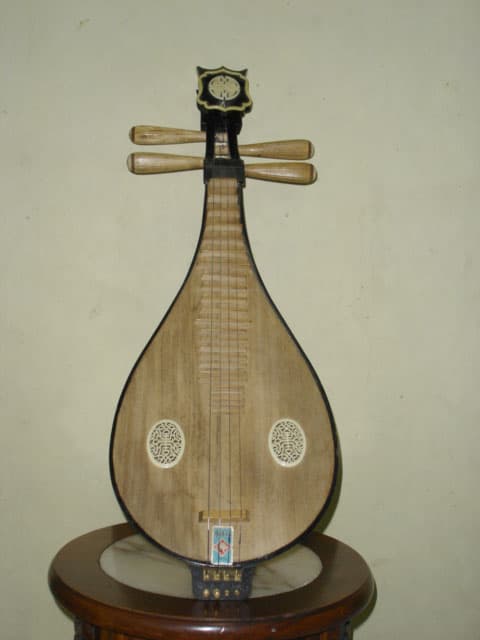
Origins: From Hollowed Willow to High-Pitched Specialist
The name liuqin contains the character for willow (柳), reflecting the early practice of hollowing out willow wood for the body. Shaped like a small pipa, it was also called 'willow-leaf qin' or 'little pipa.' It was long popular in northern Jiangsu, southern Shandong, and northern Anhui, accompanying local operas such as Liuqin opera and Sizhou opera. The earliest liuqin was simple: two strings, seven frets, a range of only a minor seventh plus an octave, and a bamboo tube worn on the finger to pluck, later replaced by a horn tube. From the 1950s, musicians systematically reformed the instrument, adding strings and frets, arranging them in equal temperament, and switching to a pick. In the 1970s, a four-string high-pitched liuqin appeared, using steel strings instead of silk and bamboo frets instead of sorghum stalks, greatly expanding range and expressiveness. This reform elevated the liuqin from opera accompaniment to solo and orchestral high-register roles, making it a highly penetrating color instrument in the plucked-string section.
Body Construction: Pear-Shaped Soundbox with Soundboard and Back
The liuqin has a pear-shaped body, smaller, shorter, and rounder than the pipa. Modern liuqin soundboards are usually made of paulownia wood, while the back is red sandalwood or rosewood; the two are glued together to form the resonant chamber. The soundboard has two prominent soundholes, often symmetrical crescent or circular shapes, to release sound waves from the box. The neck is short, with frets set into the fingerboard—traditionally bamboo, sometimes metal in modern versions—arranged in equal temperament, commonly twenty-four or twenty-nine frets. The headstock is often ruyi-shaped or spatula-shaped and holds tuning pegs; four-string high-pitched liuqin use metal geared pegs for precise tuning. Strings run from the headstock over a bridge placed slightly below the center of the soundboard, transmitting vibration to the soundboard and amplifying it through the resonant chamber. A tailpiece at the bottom anchors the strings. The compact construction favors quick response in the high register.
Acoustic Principles: The Basis of Penetrating High Notes
The liuqin follows the basic principles of chordophones: a pick plucks the string, vibration travels through the bridge to the soundboard, which drives the air inside the resonant chamber, radiating sound. The liuqin's bright, crisp, penetrating tone results from several construction factors working together. First, the small body and thin soundboard mean a limited air volume that responds readily to high frequencies while low frequencies decay quickly, keeping the sound focused and clear. Second, the short effective string length and high tension produce high fundamental frequencies, with rich, closely spaced overtones that create a bright, slightly metallic timbre. Third, steel strings increase density and tension, transmitting energy more efficiently to the soundboard and strengthening high-frequency overtones. Fourth, the bridge material and position affect transmission efficiency; bamboo or wooden bridges are designed to balance volume and tone through pressure distribution on the soundboard. Fifth, the pick's material and shape determine the excitation: celluloid, plastic, horn, or tortoiseshell picks in triangular, quadrilateral, or elongated shapes vary in hardness and elasticity, affecting the string's attack transient—hard picks yield a crisper attack, softer picks a gentler one. Together, these factors shape the liuqin's acoustic character: high, bright, crisp, and penetrating.
Playing Setup: Holding, Fingering, and Pick
When playing the liuqin, the musician sits upright and holds the instrument diagonally against the chest, with the headstock angled slightly upward to the left, similar to the ruan and yueqin. The left hand lightly supports the neck, with the thumb resting naturally behind it and the other four fingers stopping the strings, allowing free shifting between positions. The right hand is in a loose half-fist, with thumb and index finger holding the pick; the point of contact is controlled by the combined force of both fingers, with a relaxed wrist and forearm-driven motion. Picks are usually made of celluloid, plastic, horn, or tortoiseshell, in triangular, quadrilateral, or elongated shapes; material and thickness directly affect whether the tone is hard or soft. The liuqin's strings are under relatively high tension, requiring some finger strength, but the frets are closely spaced and position shifts in high registers are frequent, so the left-hand shape must be small and agile. The right-hand plucking point is usually near the bridge for a brighter tone, sometimes moving toward the fingerboard for a softer color according to the phrase. Common techniques include tan (plucking), tiao (striking), lun (tremolo), and sao (strumming); tremolo requires fast, even alternation of the pick for a dense sustained tone, while strumming emphasizes chordal impact. These organizational choices serve the clarity and agility of the liuqin's high register.
Listening Guide: How to Recognize the Liuqin's Sound
When listening to the liuqin, first grasp its register and timbre. Its sound sits in the middle-high range, with high fundamentals and dense overtones, sounding brighter and crisper than the pipa, with a metallic penetration. In Chinese orchestra, the liuqin often carries the high melodic line; even in full tutti, its voice is not easily masked, like a bright thread running above the ensemble. As a solo instrument, it excels in lively,跳跃, rhythmically distinct passages, where fast plucking and tremolo produce highly articulated streams of notes; in lyrical passages, dynamic variation and changes in plucking point yield a clear yet gentle cantabile. Listen for several details: whether the pick's contact has a clear 'grain,' the starting point of liuqin articulation; whether the tremolo is even and dense, reflecting right-hand control; whether intonation and timbre remain consistent in high positions, reflecting left-hand skill. In common public performance traditions, the liuqin often collaborates with ruan and yueqin sections, complementing timbres to form high, middle, and low layers in the plucked-string group. Beginners can first identify the liuqin's melodic line in orchestral recordings, then gradually listen to solo works to appreciate its timbral charm as it evolved from accompaniment to solo instrument.
Questions
What is the main structural difference between the liuqin and the pipa?
The liuqin has a smaller, shorter, rounder body, a shorter effective string length, and more closely spaced frets, favoring quick response in the high register; the pipa has a larger body, more frets, a wider range, and a larger resonant chamber.
What materials are liuqin picks made of, and how do they affect tone?
Common pick materials include celluloid, plastic, horn, and tortoiseshell, usually in triangular, quadrilateral, or elongated shapes. Harder materials (such as horn or tortoiseshell) produce a crisper, brighter sound, while softer or thinner picks yield a relatively gentler tone.
Why is the liuqin not easily masked by other instruments in a Chinese orchestra?
Because the liuqin has a small body, thin soundboard, short strings under high tension, and steel strings, its fundamental lies in the high register with rich, concentrated overtones. This gives strong high-frequency energy that decays quickly, resulting in a penetrating sound that remains clearly audible in ensemble.
Source: 柳琴