
Morin Khuur Construction and Acoustics: From Soundbox to Horsehair Strings
Explore the morin khuur's construction and acoustics: how its wooden soundbox and horsehair strings create its deep timbre, plus playing setup and listening tips.
1. Origins and Formal Evolution of the Morin Khuur
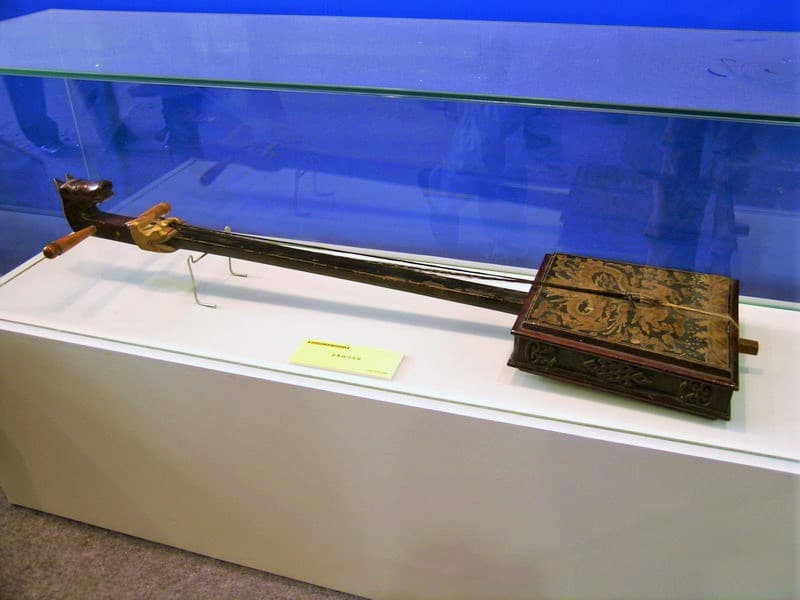
The morin khuur is the most iconic bowed string instrument of the Mongolian people; its Mongolian name, morin khuur, means 'horsehead fiddle.' Its ancestry traces back to the huqin family of bowed instruments of the Tang and Song periods, and it was already circulating among the people by the time of Genghis Khan. A grassland legend tells of a herdsman who, mourning his dead foal, made a fiddle from its bones, with a horse's head carved at the top of the neck—hence the name. In the Khorchin grasslands it is called 'shoor,' while in the Xilin Gol and Chahar regions it is known as 'hihil-hor.' The two are structurally similar but differ in tuning, string placement, and outward form. Traditional morin khuur are made of hardwood, with soundboxes in inverted-trapezoid, rectangular, and other shapes; large instruments measure about 120 cm in length, small ones about 70 cm. In the late 20th century, Qi Baoligao carried out several reforms, expanding volume and range and replacing the python-skin soundboard with white pine, giving this ancient instrument a more stable acoustic profile in modern contexts.
2. Soundbox and Neck: The Physical Basis of Sound
The body of the morin khuur is made of hardwood, and the soundbox is the core of its sound production. Traditional soundboxes are mostly inverted-trapezoid or rectangular, with both faces covered in patterned horsehide or sheepskin, creating two vibrating surfaces front and back. The neck runs through the box, topped with a carved horse's head that serves both as ornament and as a counterbalance to string tension. The strings are distinctive: multiple strands of horsehair are grouped into two bundles, usually tuned in fourths. Horsehair has a texture unlike silk or steel strings; its fibrous structure generates rich overtones when vibrating, giving the morin khuur its round, deep, and mellow timbre. The bow, also made of horsehair, is threaded between the two strings and played with the bow outside the strings—a layout that allows the player to sound both strings at once, facilitating double stops. The soundbox's skin or wooden soundboard acts as a vibrating membrane, coupling string vibrations into the air; its material and tension directly affect the brightness and depth of the tone.
3. Horsehair Strings and Bowing: The Core of Sound Production
The morin khuur's sound production rests on the frictional interaction between horsehair strings and a horsehair bow. As the bow hair rubs the strings, microscopic scales on the hair create a stick-slip vibration against the string surface; this process excites lateral string vibration, which is transmitted through the bridge to the soundbox. The uniqueness of horsehair strings lies in their flexibility and internal damping: compared with metal strings, horsehair strings decay faster and high-frequency overtones are moderately suppressed, yielding a warm, non-harsh timbre. In playing, the lower-left corner of the soundbox is held between the knees, the instrument stands nearly upright, and the right hand draws the bow between the strings. The morin khuur can produce double stops and harmonics, often imitating a horse's neigh; when accompanying folk songs, it frequently uses third- and fourth-based trills to mimic singing. In fingering, the morin khuur differs from ordinary bowed instruments: the player presses the strings from left to right with the base of the index and middle fingernails rather than pressing from the front—a distinctive touch that further shapes its sound. Traditional tunings include the straight fourth A–d, the reverse fourth a–e, and the western-region fifth d–a; different tunings affect string tension and resonance, thereby altering timbre and playing convenience.
4. From Solo to Ensemble: Organization and Contemporary Practice
Traditionally, the morin khuur is used for solo playing, ensemble with instruments such as the sihu, and accompaniment of folk songs and storytelling. Its relatively soft volume and deep timbre suit the creation of an intimate atmosphere in small spaces. Since the 1980s, the instrument's organizational modes have changed markedly: in 1986, Qi Baoligao gathered outstanding Inner Mongolian musicians, standardized bowing, rhythm, and fingering, and formed a morin khuur ensemble—pioneering morin khuur ensemble playing. In 1989, the Chinese Morin Khuur Society was established in Hohhot, promoting standardization in performance and teaching. In 2001, a thousand morin khuur players performed 'Ten Thousand Galloping Horses' together, setting a Guinness World Record and demonstrating the instrument's expansion from individual narrative to collective sound. In 2011, the International Morin Khuur College was founded at Xilin Gol Vocational College, bringing performance and instrument-making into higher education. These practices have allowed the morin khuur to develop new forms such as ensemble and concerto while retaining its traditional timbre, and soundbox reforms have supported its sound projection in larger venues.
5. Listening Points: How to Hear the Morin Khuur's Acoustic Character
When listening to the morin khuur, begin with timbre: notice its round, deep character and the warm overtones produced by horsehair strings. In traditional solo playing, the sound often imitates a horse's neigh, the flow of wind, and the herdsman's song; listeners can attend to how the player uses third- and fourth-based trills to mimic the human voice, as well as the use of double stops and harmonics. In ensemble or concerto settings, focus on how the morin khuur maintains its identity within a collective sound, and on changes in volume and range following soundbox reforms. In contemporary public performances, the morin khuur often collaborates with piano, symphony orchestra, or electronic sound; listeners can compare timbral differences between traditional solo and cross-genre collaboration. In addition, different tunings (straight fourth, reverse fourth, fifth) alter string tension and resonance, thus affecting the brightness or darkness of the timbre; listeners can notice color changes when the same piece is played in different tunings. It is advisable to start with solo miniatures and folk-song accompaniment, then gradually expand to ensemble and concerto works, experiencing the morin khuur's acoustic journey from grassland narrative to the contemporary stage.
Questions
Why are morin khuur strings made of horsehair?
Horsehair is flexible and has relatively high internal damping, producing warm, round overtones and moderately suppressing high frequencies, which creates the morin khuur's distinctive deep timbre.
Why do morin khuur soundboxes come with either skin or wooden soundboards?
Traditional soundboxes are covered with horsehide or sheepskin for a deep tone; late 20th-century reforms adopted white pine soundboards for more stable vibration and greater volume, suiting ensemble and stage performance.
Does the morin khuur's tuning affect its timbre?
Yes. Straight-fourth, reverse-fourth, and fifth tunings alter string tension and resonance, affecting timbral brightness and playing convenience, with subtle differences in perceived sound.
Source: 马头琴