Morin Khuur Masters and Lineage: From Grassland Fiddlers to Conservatory Traditions
Explore the lineage of morin khuur performers, from oral-tradition grassland fiddlers to conservatory-trained masters, and learn how to hear stylistic differences.
Where the Lineage Begins: Oral Tradition and Instrument Reform
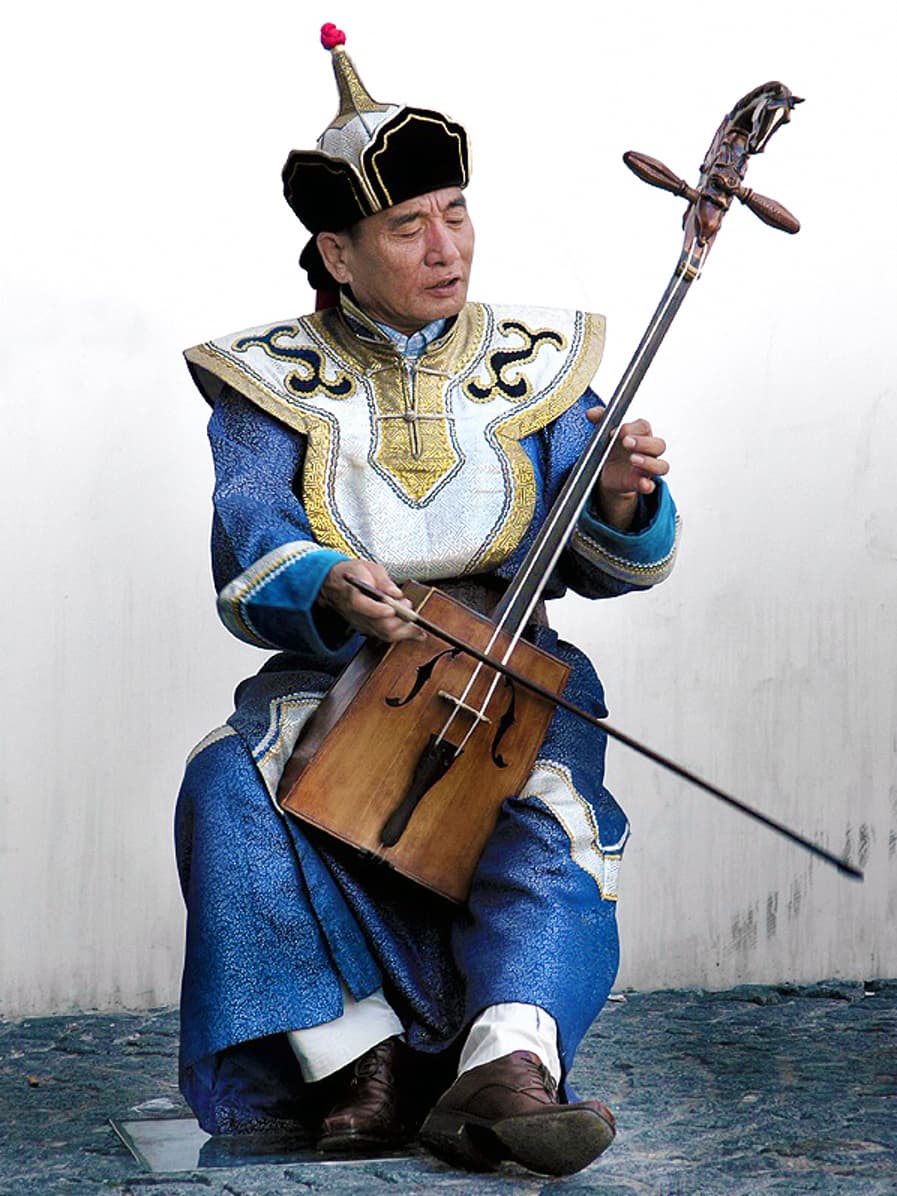
The performance lineage of the morin khuur has never had a single source. Before the mid-20th century, it was embedded in pastoral Mongolian life—naadam festivals, weddings, storytelling, and long-song accompaniment—and players were mostly folk artists whose skills passed from master to apprentice by oral transmission and immersion, without unified textbooks or notation. Players in different regions had their own habits of tuning, fingering, and bowing; in the Khorchin grasslands the instrument was called “shoor,” while in Xilin Gol and Chahar it was known as “hihil-hor,” and these names point to local performance traditions. In the second half of the 20th century, as professional music education took root in Inner Mongolia, the morin khuur entered the classroom, and the role of performer-teacher emerged. Transmission shifted from a purely folk master-apprentice system to a dual structure of “folk foundation plus conservatory training.” The pivotal figure in this shift is Chi Bulag: he reformed the instrument in 1973 and again in 1983 to expand volume and range, switched to a white pine soundboard in 1996, and incorporated techniques from violin, erhu, sihu, and cello into morin khuur playing, developing bowing techniques such as jumping bow, striking bow, tremolo bow, and continuous jumping bow. These reforms were not merely craft issues; they redefined who could teach, how teaching was done, and what was taught, paving the way for later conservatory lineages.
How the Lineage Is Organized: From Individual Players to Ensembles and Academies
Traditionally, morin khuur transmission centered on individual players: a respected fiddler took on a few apprentices, and style passed through specific pieces and playing habits rather than abstract technical norms. This model was flexible but hard to scale. Chi Bulag’s contribution was to organize scattered individuals into a reproducible collective: in 1986, he brought together many outstanding morin khuur artists from Inner Mongolia, unified their bowing, rhythm, and fingering, and formed a morin khuur ensemble—later the Chi Bulag Wild Horse Morin Khuur Ensemble—pioneering morin khuur ensemble playing. In 1989, the Chinese Morin Khuur Society was established in Hohhot with Chi Bulag as president, becoming an organizational platform connecting players across regions. In 2001, at the Hohhot International Youth Morin Khuur Art Festival, he led 1,000 players in performing “Ten Thousand Galloping Horses,” setting a Guinness World Record—an event that symbolically demonstrated the possibility of scaled transmission. In 2011, Xilin Gol Vocational College established the Chi Bulag International Morin Khuur Academy, the only higher-education institution in China with a morin khuur major, teaching both performance and instrument making, thus bringing transmission into the track of degree education. In 2014, the first China International Morin Khuur Academic Symposium was held, and academic exchange began to run parallel with stage practice. This organizational lineage shows that morin khuur transmission is not a single line but a layered structure of folk apprenticeship, ensemble performance, society networks, and conservatory education.
Portraits of Notable Performers: Players on Different Paths
When discussing notable morin khuur performers, it helps to distinguish several paths of development, because the path itself shapes style. The first is the deeply rooted folk player, without conservatory training but possessing a large repertoire of local pieces and improvisational skills for long-song accompaniment; their value lies in preserving the instrument’s direct link to life contexts. The second is the reformer-organizer, represented by Chi Bulag, whose contribution lies not only in performance but in instrument reform, technical integration, and institution building, transforming the morin khuur from a folk instrument into a modern instrument that can be taught and played in ensembles. The third is the conservatory-trained performer, raised on systematic methods and ensemble training, technically standardized and strong at sight-reading, often active on solo stages and in cross-genre collaborations. The fourth is the transnational player active in both Mongolia and Inner Mongolia, whose playing is shaped by traditions and contemporary compositions from both sides. It should be noted that specific teachers, recording versions, and award histories of individual performers should be based on publicly verifiable sources; this article does not list unverified personal biographies one by one. For listeners, the point is not to memorize names but to hear the stylistic differences that different paths produce: folk players tend to play closer to the breath of speech and song, while conservatory players pay more attention to intonation, tonal uniformity, and structural control in large works.
How to Listen Today: From Lineage to Listening Cues
To turn lineage into listening cues, start from three levels. First, listen for “sense of language.” Players with deep folk roots often play with pronounced cantabile quality, phrasing that breathes like Mongolian long-song, and freer use of ornaments and slides; conservatory-trained backgrounds tend to fit phrases into more regular meter and structure. Second, listen for “ensemble awareness.” In solo playing, the player can stretch tempo freely, but in ensemble playing, bowing, fingering, and rhythm must be unified—and that unification is itself the legacy of Chi Bulag’s reforms and ensemble practice. When listening to ensemble works, notice the balance between voices and the uniformity of bowing; these are important indicators of a morin khuur ensemble’s training level. Third, listen for the “period marks of instrument and technique.” The reformed morin khuur has greater volume and wider range, the white pine soundboard brings brighter resonance, and new bowing techniques such as jumping bow, striking bow, and tremolo bow in fast passages became widespread only after the second half of the 20th century. Listening across periods reveals how changes in the instrument itself affect musical expression. For beginners, it is advisable to start by comparing solo playing with long-song accompaniment, then move on to ensemble playing and large-scale works, so that the tension between individual style and collective norms becomes easier to discern.
Questions
What are the main types of morin khuur lineage?
Roughly four types: folk oral-tradition players, instrument reformers and organizers, conservatory-trained performers, and transnational players active in both China and Mongolia. These paths overlap and together form the contemporary transmission structure.
What was Chi Bulag’s greatest contribution to morin khuur transmission?
He organized scattered folk players into a reproducible system of teaching and ensemble playing: unifying bowing and fingering, forming an ensemble, establishing a society, and promoting conservatory education, shifting morin khuur from individual apprenticeship to scaled, institutional transmission.
How can I tell folk style from conservatory style when listening to morin khuur?
Folk style usually has freer phrasing, with ornaments and slides closer to long-song singing; conservatory style tends to have more uniform intonation and tone color, more regular rhythm and structure, and greater bowing uniformity in ensembles.
Source: 马头琴