
Pipa Construction and Acoustics: From Pear-Shaped Body to Vibrating Strings
How do the pear-shaped body, bent neck, and fret system shape the pipa's unique sound? Explore pipa construction, acoustics, and listening tips.
1. Origins: From 'Struck on Horseback' to the Pear-Shaped Body
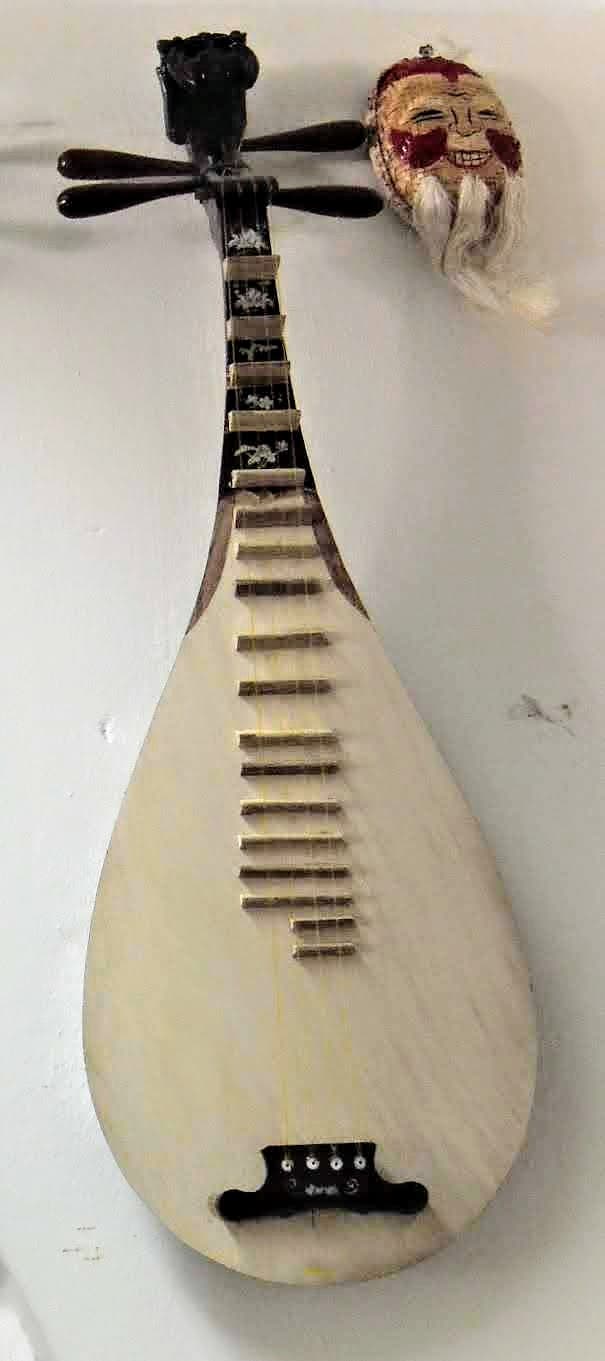
The term 'pipa' first appears in Ying Shao's Fengsu Tongyi of the Eastern Han. Liu Xi's Shiming explains the name comes from playing motions: 'pushing forward is pi, drawing back is pa.' Before the Tang dynasty, pipa was a generic term for all short-necked plucked lutes. The Qin-Han 'pipa' had a round body and straight neck, closer to the later ruanxian. The foundation of today's pipa was laid by the curved-neck pipa introduced from Kucha during the Tang—its pegbox bends back at nearly a right angle, and its soundbox is pear-shaped. This form was standardized in the Ming dynasty and persists today. The four-string curved-neck pipa shares a common ancestor with the West Asian oud and European lute, while the five-string straight-neck pipa is thought to originate from India; its only surviving example, the 'Mother-of-Pearl Inlaid Red Sandalwood Five-String Pipa,' is housed in the Shosoin in Japan. Understanding this lineage is the first step to understanding pipa construction: it is not a single-bloodline product but a convergence of multiple short-necked plucked traditions in East Asia.
2. Construction: Acoustic Roles of Soundbox, Neck, and Frets
The modern pipa's construction can be divided into three acoustic zones. First, the soundbox: a pear-shaped wooden shell with a paulownia soundboard and hardwood backboard (rosewood, sandalwood, etc.). The thin, elastic soundboard converts string vibrations into air sound; the hard backboard reflects waves and colors the tone. Second, the neck and pegbox: the neck connects the soundbox to the pegbox, which characteristically bends backward, housing the tuning pegs for four strings. Third, the fret system: modern pipas typically have six 'xiang' (large frets on the neck) and twenty-four or more 'pin' (small frets on the soundboard), together forming a chromatic scale. The number of frets has expanded from around twelve in ancient times to over thirty today, enabling transposition and complex melodies. String vibrations travel through the bridge to the soundboard, which drives air resonance inside the body, finally reflected and reinforced by the backboard, producing the pipa's characteristic penetration and granularity.
3. Acoustics: The Chain of String Vibration, Transmission, and Resonance
The pipa's sound is a transmission chain from string to air. When plucked, the string vibrates laterally; its fundamental frequency determines pitch, and its harmonic series determines timbre. Vibrations pass through the bridge to the soundboard, which bends and vibrates, driving air inside the body into Helmholtz resonance. The pear-shaped curve is not merely aesthetic: it distributes air more evenly, reduces standing-wave dead zones, and makes lows fuller and highs clearer. The hardwood backboard acts as an acoustic mirror, reflecting inward waves back to the soundboard to reinforce overall volume. Frets alter the string's effective vibrating length; the lower the stopping position, the shorter the vibrating segment and the higher the pitch. The material and height of xiang and pin also affect transmission efficiency: xiang are often hardwood or ivory substitutes, pin are usually bamboo; their density differences subtly alter timbre across registers. Additionally, the four strings differ in gauge and tension; the wound low string vibrates more slowly with richer harmonics, giving the pipa's low register its characteristic thickness.
4. How to Listen Today: Listening Tips Grounded in Construction
With construction in mind, listening to the pipa becomes more targeted. First, notice the 'granularity' of tone: a result of the thin, hard soundboard and fast string decay. In 'Ambush from Ten Sides,' the tremolo and strumming reveal each note's independence and continuity. Second, distinguish registers: the wound low string gives depth to the low register, while the high register is bright; in lyrical pieces like 'Song of the Frontier,' note the crystalline quality of high melodies. Third, feel the soundbox 'breathe': in long notes or harmonics, the resonance between soundboard and internal air creates a lingering sustain. Martial pieces use techniques like 'sha xian' and 'jiao xian'—unconventional string-to-soundboard contact producing noise effects—also a construction-determined sonic resource. Fourth, note the fret system's transposition capability: modern pipa modulates freely; in works like 'Little Sisters of the Grassland,' observe color changes as the same melody moves through different keys. In public performance traditions, lyrical pieces emphasize left-hand portamento and vibrato, while martial pieces emphasize right-hand force and rhythm—each leveraging the instrument's construction differently.
5. Evolution of Construction and Acoustic Pursuits in the Modern Pipa
Pipa construction has never been static. From the Tang curved-neck pipa to the Ming-standardized four-string pipa, and to twentieth-century refinements, soundbox dimensions, fret numbers, and string materials have continuously evolved. Since the mid-twentieth century, to meet the demands of Chinese orchestral ensembles, the pipa's volume, intonation, and transposition capabilities have been further enhanced: frets increased to over thirty, string tension raised, and soundboard thickness more precisely selected. These refinements allow the pipa to maintain clear voice lines in both solo and ensemble settings. Meanwhile, the aesthetic value of traditional construction persists: the warm tone of older pipas and the bright penetration of contemporary ones each have adherents. When listening, notice the timbral differences arising from different construction approaches—this is not merely a technical matter but an aesthetic choice.
Questions
How does the pipa's pear-shaped soundbox affect its tone?
The pear-shaped curve distributes air more evenly, reducing standing-wave dead zones for fuller lows and clearer highs, while the hardwood backboard reflects waves to enhance overall volume and penetration.
What is the difference between xiang and pin on the pipa?
Xiang are large frets on the neck, often hardwood or ivory substitutes; pin are small frets on the soundboard, usually bamboo. Together they form a chromatic scale, and their density differences subtly alter timbre across registers.
Why does the pipa's low register sound especially thick?
The low string uses a wound structure—thicker, higher tension, vibrating more slowly with richer harmonics. Combined with the soundbox's low-frequency amplification, this gives the low register its characteristic thickness and sustain.
Source: 琵琶