
Xiao Construction and Acoustics: From Bamboo Tube to Edge Tone
The xiao is a vertical open-ended bamboo flute. This article explains its construction, edge-tone acoustics, and how to listen to its timbre.
1. Origins and Organological Identity of the Xiao
The xiao is an ancient Chinese vertical, open-ended, end-blown edge-tone instrument, commonly called xiao or dongxiao today. Before the Tang dynasty the term xiao mostly referred to the panpipe; from the Tang and Song onward the single-tube vertical flute grew popular, and the panpipe was distinguished as paixiao, while the name dongxiao derives from the hole at the bottom of the tube. Before the Han dynasty both vertical and transverse flutes could be called di; after Jing Fang of the Western Han added a back hole, the structure was basically consistent with today's dongxiao. In the Tang dynasty the vertical flute, about one chi and eight cun long, was called chiba (shakuhachi) and transmitted to Japan as the ancient shakuhachi. Yuan dynasty banquet music already records a five-hole xiao, and in the Ming and Qing the single-tube vertical xiao was more clearly distinguished from the panpipe and transverse di, leaving independent notation. In the twentieth century Peng Zhiqing created the eight-hole ya-xiao (qin-xiao), emphasizing twelve-tone equal temperament for ensemble playing; today's eight-hole xiao developed from this. Organologically, the xiao is an open-ended edge-tone instrument: both ends of the tube are open, and the air stream splits at the edge of the blowhole to produce sound, acoustically distinct from stopped pipes and reed pipes.
2. Bamboo, Bore Diameter, and Length: Basic Variables of Construction
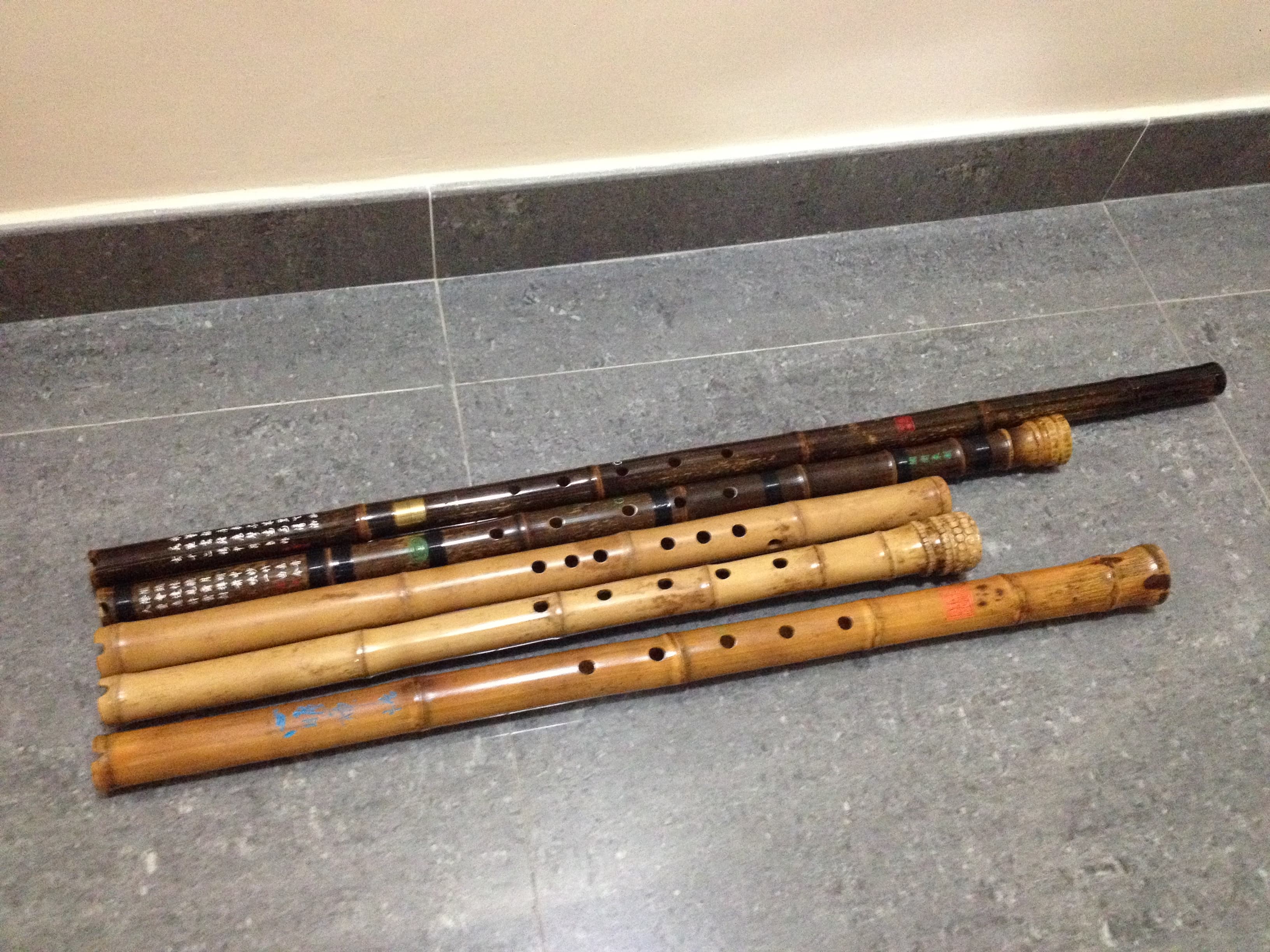
The xiao is mostly made of bamboo; purple bamboo (zizhu) is prized for its high density and fine grain, while guizhu, mengzongzhu, and shizhu are also common. The material must be thoroughly dry and free of cracks, with a smooth inner wall; the position of nodes affects the continuity of the bore. Traditional xiao retain the bamboo root end; those with a thicker, shorter tube are called nanxiao (southern xiao), represented by the Fujian nanguan dongxiao, with five front holes and one back hole, ten nodes and nine sections, and a V-shaped blowhole, producing a deep, rich timbre. Slender, longer tubes such as the qin-xiao, also called beixiao (northern xiao), often lack the root end, have a cap, a longer body, and lower volume. Tube length determines the fundamental frequency: the longer the tube, the lower the pitch. Bore diameter and wall thickness affect timbre and intonation: a wider bore gives a full low register and rich overtones, while a narrower bore yields a brighter tone. Blowholes cut inward in a U or V shape are called U-kou or V-kou; an externally cut opening is called tang-kou, derived from the shakuhachi tradition. Finger holes may number six or eight: among six-hole xiao, those with evenly spaced holes are whole-tone xiao, while those positioned by twelve-tone equal temperament with the second and sixth holes omitted are semitone xiao; eight-hole xiao facilitate modulation and ensemble. From the late twentieth century, metal rings have divided the tube into two or three sections for tuning and portability.
3. Edge-Tone Sound Production: How Air Becomes Xiao Sound
The core of xiao sound production lies at the edge of the blowhole. The player controls the air stream with the lips, directing it obliquely across the edge of the blowhole; the air splits into two vortices that shed alternately, creating periodic pressure fluctuations that excite the air column in the tube. This is the edge-tone mechanism. The tube is open at both ends, so both ends are pressure nodes; the air column forms standing waves whose fundamental frequency is determined by tube length and the speed of sound, modified by end corrections. An open pipe can produce all integer multiples of the harmonic series, so the xiao's timbre contains not only the fundamental but also rich second and third harmonics, giving a round, slightly ethereal quality. The shape and inward cut of the blowhole affect the focusing of the air stream and the edge response: U- and V-shaped openings guide the air differently, while the externally cut tang-kou more readily excites higher harmonics. In playing, blowing downward or upward changes the air-stream angle, subtly adjusting pitch and timbre; overblowing excites higher harmonics to extend the range. Opening and closing finger holes changes the effective length of the tube, altering the standing-wave frequency and thus the pitch.
4. Finger-Hole Layout and Scale Organization
The traditional six-hole xiao has five front holes and one back hole, mainly diatonic with evenly spaced holes, convenient for pentatonic and heptatonic scales. The eight-hole xiao is positioned by twelve-tone equal temperament, with seven front holes and one back, allowing easier modulation and ensemble. The qin-xiao is usually eight-hole; though softer, it matches the intonation of the guqin. Hole size and spacing affect intonation and feel: larger holes give greater volume and a more open tone, smaller holes a softer timbre. Players cover holes with the pads of the fingers, sealing them tightly; leakage disrupts edge-tone excitation. The xiao's range is usually about two octaves: the low register is deep and full, the middle round, the high clear with a slight tension. Because the open pipe has rich harmonics, different timbres can be produced on the same fingering through breath control and blowing angle, creating the xiao's characteristic flavor. The nanxiao is deep in tone, the qin-xiao elegant, each with its own emphasis in repertoire and ensemble settings.
5. How to Listen Today: From Construction to Timbre
To listen to the xiao, begin with timbre: note the depth of the low register and the roundness of the middle, and feel the ethereal quality brought by open-pipe harmonics. Next, listen to the interaction of breath and edge: whether long tones are stable, whether pitch holds in soft playing, and whether the subtle pitch shifts from blowing angle sound natural. Then listen to the clarity of finger-hole action: whether fast passages are articulate, and whether slides and vibrato coordinate with the tube's resonance. Nanxiao repertoire is often somber and desolate, qin-xiao ensemble clear and distant; in silk-and-bamboo music the xiao often blends with di, sheng, and pipa, and one can notice how it remains independent without being obtrusive. Contemporary solo works often explore overblowing and multiphonic techniques; listen for changes in the harmonic series and layers of timbre. In public performance traditions, the xiao is often paired with the guqin, nanguan, and Jiangnan silk-and-bamboo; beginners can start with solo miniatures and qin-xiao duets, gradually appreciating how construction and acoustics shape the listening experience.
Questions
What is the biggest structural difference between the xiao and the dizi?
The xiao is a vertical, open-ended, end-blown edge-tone instrument without a membrane hole; the dizi is transverse with a membrane hole whose vibration contributes to the sound.
Why does the xiao sound rounder and deeper than the dizi?
The xiao is an open pipe with a wider bore and longer body, giving a lower fundamental and rich harmonics; edge-tone excitation yields a softer timbre. The dizi's membrane hole enhances high frequencies, making it brighter.
How do eight-hole and six-hole xiao differ in playing?
The eight-hole xiao is positioned by twelve-tone equal temperament, making modulation and ensemble easier; the six-hole xiao is mainly diatonic, common in traditional repertoire, with semitones produced by blowing angle and cross-fingering.
Source: 箫