
Guqin Construction and Acoustics: From Sound Chamber to Sliding Tone
How the guqin's seven strings, thirteen studs, and hollow sound chamber shape its deep, lingering tone. A guide to its construction and acoustics for listeners.
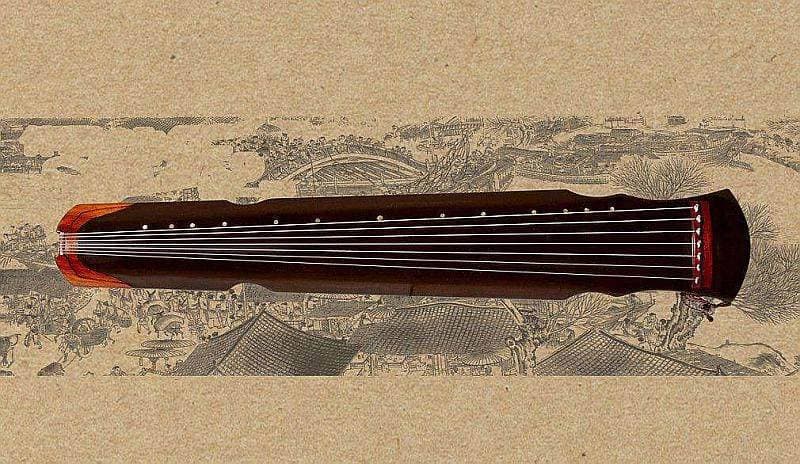
Where the Body Comes From: Cultural Logic Behind the Form
The guqin's form is not purely an acoustic design; from the outset it carried symbolic meaning as a ritual and cosmological instrument. The body is traditionally about three chi, six cun, and five fen long, corresponding to the 365 days of the year. The top is arched and the bottom flat, echoing the round heaven and square earth. It began with five strings and later increased to seven, generally associated with the seven stars of the Big Dipper or the seven celestial bodies. Thirteen studs, called hui, are inlaid along the outer edge of the soundboard to mark harmonic and stopped-string positions, symbolizing the twelve months plus a leap month. These numerical correspondences were not later inventions but were gradually fixed within the ritual and musical system from the pre-Qin through the Han dynasty. Unlike the guzheng, the guqin has no movable bridges; the strings stretch directly between the upper nut (yueshan) and the lower bridge (longyin), a structure that determines its distinctive mode of vibration and tonal character.
Soundboard and Backboard: How the Sound Chamber Shapes Tone
The acoustic heart of the guqin lies in the resonance chamber formed between the soundboard and the backboard, known as the caofu. The soundboard is typically made of paulownia or fir, while the backboard uses catalpa or other dense woods—one light, one heavy, one yang, one yin—creating a vibration pair that balances stiffness and flexibility. The thickness of the soundboard, the depth of the chamber, and the placement of the naying block directly determine whether the tone is loose and open or tight and focused. The maker carves the inner chamber to varying depths and cuts two sound holes in the backboard: the larger longchi in the upper-middle area and the smaller fengzhao lower down. These holes are not merely exits for sound; they also help regulate the air vibration inside the cavity. The naying structure—a slightly raised wooden block above each hole—suppresses excessive resonance, keeping the tone from becoming muddy. The guqin's voice is thus a collaboration among soundboard, backboard, chamber, and sound holes; even a minute change in any one of these leaves its mark on the sound.
Seven Strings and Thirteen Studs: How the Pitch System Organizes Sound
The seven strings, numbered one to seven from the outer to the inner side, are traditionally tuned to a pentatonic scale. The most common tuning is the standard mode: string one is zhi, two is yu, three is gong, four is shang, five is jue, six is zhi (an octave above string one), and seven is yu (an octave above string two). The thirteen studs are placed at harmonic nodes along the string, from the upper nut to the lower bridge, corresponding to ratios such as one-half, one-third, and one-quarter of the string length. Touching a string lightly at a stud without pressing it to the board produces a harmonic, with a clear, bell-like timbre. Pressing the string with the left hand between studs and sliding it after the right hand plucks produces the sliding tone, or zoushou yin, the guqin's most recognizable technique. Pressed tones, harmonics, and open-string tones—corresponding to firm stopping, light touching, and open strings—form the entire vocabulary of guqin music. Notably, the guqin has no frets or bridges, so pitch depends entirely on the player's ear and muscle memory, which means the same piece can differ subtly in intonation and flavor from one player to another.
Materials and Craft: The Birth of a Guqin
Traditional guqin making follows the principle: 'Choose good materials, apply deep intention; after five hundred years, there is true tone.' The soundboard is best made from aged paulownia or fir, naturally dried for many years, even a century or more, to prevent future cracking and warping. The backboard uses tightly grained catalpa or other dense wood to contrast in density with the soundboard. Strings were once made of silk, either wound or plain, producing a warm but fragile tone; today nylon-steel or synthetic fiber strings are common, offering greater volume and durability, though traditional players still prefer the subtle layers of silk strings. Fittings such as the upper nut, lower bridge, chenglu, and jiaowei are small but affect the transmission of string vibration and playing feel. The ash layer is a crucial step: a mixture of deer horn powder and raw lacquer is applied repeatedly to the wooden body, then sanded and coated with finishing lacquer. The thickness and evenness of this layer directly influence the openness and durability of the tone. A fine guqin often takes years, even a decade or more, to complete, and the instrument continues to 'open up' with long-term playing, its voice gradually becoming more relaxed and rounded.
How to Listen Today: From Construction to Appreciation
When listening to the guqin, one can approach it on three levels. First, listen to the contrast among open-string, pressed, and harmonic tones: open strings sound deep and broad; pressed tones, firmly stopped against the board, are solid and tense; harmonics, lightly touched at the studs, ring clear like pearls falling on jade. In a single piece, these three timbres alternate, creating rich shifts of light and shade. Second, listen to the flavor of the sliding tone: as the left hand glides along the string, the changes in pitch and the faint friction sound produce the guqin's unique 'vocal resonance,' imitating the turns of the human voice and conveying the player's breath and emotion. Third, listen to the instrument's resonance and sustain: the design of the sound chamber and sound holes determines how the sound lingers. A fine guqin has a long, clear sustain—low notes loose and deep, high notes bright and crisp. In public performances, players often shift timbre and rhythm within a single piece; listeners can attend to these moments of transition. Guqin music does not pursue grand volume but reveals its mastery in subtle details. A quiet environment and a relaxed mind often reveal more than expensive equipment.
Questions
Why does the guqin have no bridges?
The guqin's strings stretch directly between the upper nut and the lower bridge, with no movable bridges. This structure transmits string vibration directly to the soundboard, producing its distinctive pressed and sliding tones, but it requires the player to control pitch entirely by ear and muscle memory.
How do the sound chamber and sound holes affect the guqin's tone?
The sound chamber between the soundboard and backboard determines whether the tone is open or tight. The two sound holes—longchi and fengzhao—release sound and regulate air vibration inside the cavity, while the naying blocks suppress excessive resonance, keeping the tone clear rather than muddy.
What is the difference between harmonic and pressed tones on the guqin?
Harmonics are produced by lightly touching a stud with the left hand while plucking with the right, giving a clear, bell-like timbre. Pressed tones are made by firmly stopping the string against the soundboard, producing a solid, tense sound. Together with open-string tones, they form the guqin's three basic timbres.
Source: 古琴