
Yangqin Construction and Acoustics: From Trapezoidal Soundbox to Hammered Strings
Explore the yangqin's trapezoidal soundbox, strings, and hammers, revealing the acoustics of hammered strings and the evolution of its construction.
1. Origins and Form: From Santur to Chinese Yangqin
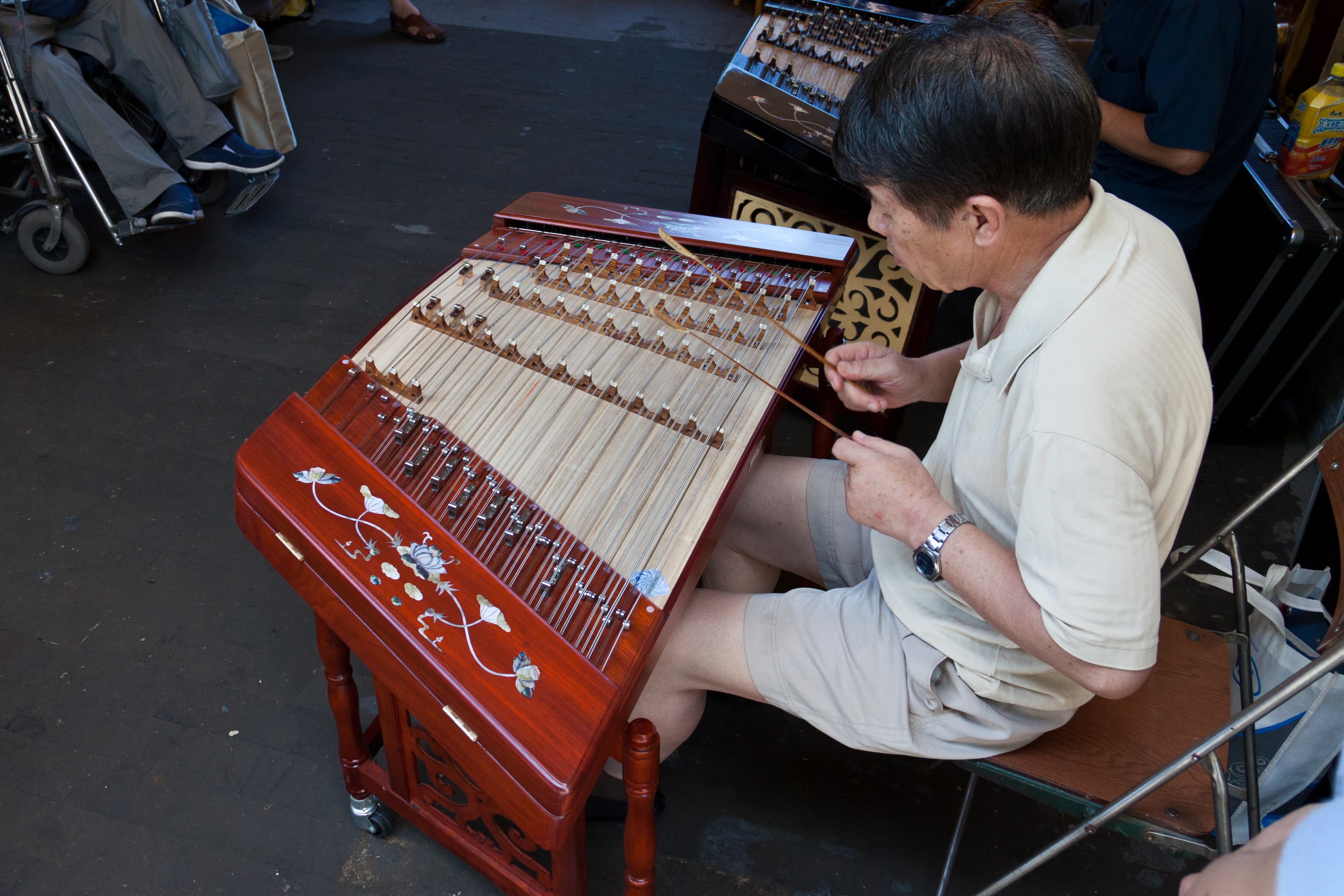
The yangqin is not native to China; its ancestor can be traced to the Central Asian santur, and it is generally believed to have entered China by sea during the Ming dynasty. Originally written as 洋琴 (foreign zither), the first character was changed to 扬 in the early 20th century, preserving the pronunciation while adding connotations of 'acclaimed' or 'spirited.' This name change itself encapsulates the instrument's journey from foreign import to local adoption. The core of the yangqin's construction is a trapezoidal soundbox with dozens of metal strings stretched over a soundboard, sounded by striking with hammers. This structure combines the excitation method of percussion with the vibrating system of strings; in Chinese orchestras it is usually grouped with plucked strings, yet its acoustics are closer to struck chordophones. Worldwide, the yangqin family is large: the European dulcimer, Middle Eastern santur, and Eastern European cimbalom are variants on the same principle, while the Chinese yangqin has developed a distinct identity in form, note layout, and playing technique.
2. Anatomy: Soundbox, Strings, and Hammers
The yangqin's construction can be broken down into three key parts: the soundbox, the strings, and the hammers. The soundbox is a trapezoidal wooden resonator; the soundboard is typically made of lightweight softwood such as paulownia to facilitate vibration, while the back is slightly thicker for reflection and support. Inside, sound bars and posts conduct vibrations and shape the resonance. The strings are the core of sound production: traditional yangqins used bronze strings, giving a soft, warm timbre; modern instruments mostly use steel strings with higher tension, greater volume, and more stable tuning. Strings are grouped, each group containing several strings of the same pitch, tuned by wrest pins arranged along the sides. The hammers (qinzhu) are made of bamboo with tips fitted with elastic rubber or felt, providing sufficient excitation while avoiding metallic noise. The hardness, weight, and elasticity of the hammer tips directly affect timbre: harder rubber yields a bright, crisp sound; softer rubber produces a mellow, restrained tone. The instrument rests on a stand, and some modern models include a damper mechanism to control sustain.
3. Acoustics: Striking, Vibration, and Resonance
The yangqin's sound begins with the hammer striking the string. When the hammer tip hits the string at a certain speed, the string acquires initial displacement and velocity, then leaves the hammer and vibrates freely. String vibration follows transverse wave principles: the fundamental frequency is determined by string length, tension, and linear density—shorter, tighter, and lighter strings yield higher pitches. The yangqin divides strings into different lengths via bridges to set pitches; the striking position (near the bridge or the middle) affects the overtone ratio and thus timbre. Vibrations travel through the bridge to the soundboard, which in turn excites the air inside the soundbox, creating resonance. The trapezoidal shape and internal bracing shape the frequency response, reinforcing certain bands to produce the yangqin's bright yet full tone. The instant of impact also contains a broadband noise component—the 'strike noise'—which gives the attack a percussive quality and is a key marker of the instrument's identity. Sustain depends on string damping, bridge transmission efficiency, and whether dampers are used.
4. Evolution of Models: From Small Yangqin to Multi-Bridge Chromatic Yangqin
Yangqin models have evolved from simple to complex. The traditional small yangqin is a two-bridge instrument with a limited range, long used to accompany narrative singing. Since the mid-20th century, to meet the needs of Chinese orchestras, equal-tempered large yangqins appeared, extending range by using chromatic tuning between the two bridges. In 1959, Yang Jingming developed a three-bridge chromatic yangqin that could temporarily modulate via rollers; a four-bridge model followed in 1961. Subsequently, five-bridge models such as the 401 and 402 addressed range, fine-tuning, and modulation with parallel bridges, layered roller boards, and modulation slots. The 501 added chromatic tuning in high and low registers and used fine-threaded wrest pins to prevent slipping; the 505 introduced steel tension rods and a double-frame structure to counteract string tension, plus a pedal damper. The 601, developed in 2004, further widened the range and adopted a horizontal 2-5 note layout for ease of playing. The core of this evolution has always centered on three needs: extending range, facilitating modulation, and stabilizing intonation.
5. Listening Guide: Understanding Timbre Through Construction
Understanding construction and acoustics gives direction to listening. First, attend to the attack: the 'crispness' at the moment of striking comes from strike noise and harder hammers, and different traditions treat it differently—Jiangnan sizhu yangqin seeks delicate refinement with a softer attack, while Cantonese music yangqin is brilliant and lively with a brighter attack. Second, listen to sustain: traditional bronze-string yangqins have shorter sustain and a warm tone; modern steel-string instruments sustain longer with fuller resonance. Third, listen to resonance: the trapezoidal soundbox emphasizes the mid-high range, making melodic lines clear and suited to leading or ornamenting. Finally, note damper use: modern yangqins with dampers can control sustain for cleaner fast passages. In ensembles, the yangqin often provides a 'pointillistic' rhythmic role, its granular timbre giving a clear rhythmic skeleton. Listen for coordination between left and right hammers—left-hammer technique is especially important in Cantonese music, shaping the fluency of ornaments.
Questions
Why is the yangqin played with hammers instead of fingers?
Hammers provide greater excitation force, enabling metal strings to vibrate fully for a bright, full volume; the elastic tips also shape timbre and avoid metallic noise. Plucking with fingers struggles to excite multiple strings of the same pitch simultaneously with comparable volume.
How does the trapezoidal soundbox affect the yangqin's timbre?
The trapezoidal shape and internal bracing determine the resonance frequency response, reinforcing mid-high frequencies for a bright, full tone; the arrangement of different string lengths also relies on the trapezoidal form for pitch distribution.
Is there a big timbral difference between modern steel strings and traditional bronze strings on the yangqin?
Yes, noticeably. Bronze strings have lower tension, a soft warm tone, and shorter sustain; steel strings have higher tension, greater volume, stable intonation, and longer sustain. The soft charm of bronze strings can still be heard in traditional Jiangnan sizhu and Chaozhou music.
Source: 揚琴