
Yangqin Signature Pieces: A Listening Guide from Hantianlei to Jiangjunling
A guide to signature yangqin pieces: listen for Cantonese hua-jia ornamentation in Hantianlei, the delicate Jiangnan sizhu style, and the robust Sichuan idiom.
Where the Repertoire Comes From: Regional Schools and Their Pieces
The yangqin repertoire did not emerge in isolation; it grew from the soil of regional ensemble and narrative traditions. After the instrument entered China by sea during the Ming dynasty, it served as an accompanying or ensemble instrument in Cantonese music, Jiangnan sizhu, Sichuan yangqin narrative singing, Shandong qinshu, and Chaozhou xianshi, gradually accumulating pieces in which the yangqin plays a core role. In Cantonese music, Yan Laolie's arrangements of Hantianlei, Daochuilian, Lianhuankou, Daochunlai, and Guilaiyan, often using the 'zuoyin chenda' technique, became staples of the Cantonese yangqin repertoire. Jiangnan sizhu pieces such as Huanlege, Yunqing, and Xingjie require a light, delicate, and elegant touch, described as 'a wisp of smoke' on the yangqin. Sichuan yangqin pieces are closely tied to the narrative singing genre's qupai and tend toward a joyful, robust style. Chaozhou xianshi pieces like Hanya Xishui and Pingsha Luoyan are played plainly, with little use of tremolo, but the head-board ornamentation demands clear articulation. These pieces are not isolated solo works but part of a larger genre ecology; listening should place them back in their ensemble or accompanying context.
How the Music Is Organized: Bamboo Techniques, Ornamentation, and Structure
The organizing core of yangqin repertoire lies in 'bamboo technique'—how the bamboo hammers are used. Cantonese music yangqin emphasizes ornamental figuration and decorative development, with distinctive techniques such as maotou, diewei, double-held doubled notes, and zengyin with tremolo, often handled with 'left-bamboo technique' to create a brilliant, lively, and flowing style. The hammer symbols created by Yi Qiren in his 1920 Yuequ Yangqin Pu were adopted by later players, and Qiu Heshou's theory of 'ten degrees of bamboo technique' are keys to understanding Cantonese yangqin pieces. Jiangnan sizhu yangqin uses dotted rhythms and short tremolo strokes, aiming for lightness and elegance, with ornamentation that is not dense but precisely placed. Sichuan yangqin stresses special technical effects, with repertoire organization emphasizing contrast and momentum. Chaozhou xianshi uses little tremolo; head-board ornamentation demands clear articulation, and the various 'cui' techniques require tight contrast, while the yangqin keeps a plain character. Structurally, many traditional pieces unfold through 'banshi variation' or 'qupai linking'; listeners can follow how the same tune is varied at different tempos and how ornamentation increases or decreases with emotional progression.
How to Listen Today: From Ensemble Context to Solo Detail
Listening to yangqin repertoire today can proceed on three levels. The first is genre context: when hearing the Cantonese piece Hantianlei, notice how the yangqin interacts with gaohu and qinqin, and how its ornamentation fills melodic gaps and drives the rhythm; in Jiangnan sizhu, observe how the yangqin's 'wisp of smoke' timbre interweaves with dizi and erhu; in Sichuan yangqin, sense the connection between its robust momentum and narrative singing inflections. The second level is bamboo technique detail: focus on the striking point and dynamic changes of the hammers, whether ornamental figures are dense or sparse, whether tremolos are long or short, and where double stops and zengyin appear. The third level is structure: note tempo changes, the junctions of linked qupai, and the variation logic of the same tune across sections. For beginners, start with Cantonese pieces like Hantianlei and Lianhuankou—familiar melodies and brisk rhythms make ornamental patterns easy to grasp; then move to Jiangnan sizhu's Huanlege and Yunqing to appreciate lightness and elegance; finally explore Sichuan yangqin and Chaozhou xianshi to feel the instrument's regional personalities. Don't aim to 'catch every note'; first build an overall impression of timbre, technique, and genre style.
Repertoire and Instrument Types: Which Pieces Suit Which Yangqin
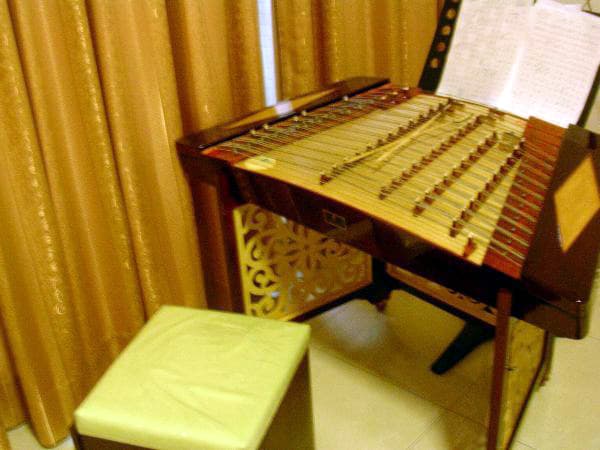
The evolution of yangqin types also affects how repertoire sounds. The traditional small yangqin, with two bridges, was long used to accompany narrative singing; its narrower range and softer timbre suit vocal genres like Shandong qinshu and Sichuan yangqin, and listening to such pieces means attending to how the instrument blends with the voice. The large yangqin, a two-bridge equal-tempered instrument, was developed in the 1950s by Zheng Baoheng, Zhang Zirui, Zhao Liye, and the Tianjin Instrument Factory; with a wider range, it suits ensemble and solo work. Three-bridge and four-bridge modulating yangqins, and later models 401, 402, 501, 505, and 601, gradually solved problems of modulation, range, and fine tuning. The 402 is a common 21st-century model with a layout suited to rapid playing. The 601, with note layout designed by Liu Hanli in 2004, spans B1 to f4 and uses a mainly horizontal 2-5 arrangement; representative pieces include Jinling Si: Manxiang Suixiang, Lishan Chiyang, and Zhuxiao Qinmeng. When listening to these modern works, notice the harmonic layers and rapid modulations enabled by the wide range, contrasting with the plain timbre of traditional small-yangqin repertoire.
A Beginner's Listening Path: From Familiar Melodies to Style Recognition
A listening path for beginners could be arranged as follows. First, choose Cantonese pieces Hantianlei and Lianhuankou: both have widely circulated melodies and brisk rhythms; focus on how the yangqin's ornamentation unfolds around the main tune, and where techniques like maotou, diewei, and zengyin with tremolo appear. Second, listen to Jiangnan sizhu's Huanlege and Yunqing, sensing the yangqin's delicate timbre in ensemble, noting dotted rhythms and short tremolo strokes, and appreciating the saying 'a wisp of smoke.' Third, hear Sichuan yangqin qupai and the Chaozhou xianshi piece Hanya Xishui: the former for robust momentum and narrative inflections, the latter for plain technique and the articulation of head-board ornamentation. Fourth, if interested, explore modern solo works, attending to the harmony and modulation effects of wide-range yangqins. At each step, don't rush; listen to a piece several times, first catching the melody, then the bamboo technique, finally the structure. You can also compare how the same tune is treated in different genres—for example, Daochunlai in Cantonese music versus Jiangnan sizhu—to build a sense of the yangqin's stylistic diversity.
Questions
Which signature yangqin pieces are best for beginners to start with?
Start with Cantonese pieces Hantianlei and Lianhuankou—familiar melodies and brisk rhythms make ornamentation easy to follow; then try Jiangnan sizhu's Huanlege and Yunqing for delicate elegance.
How can I distinguish Cantonese yangqin 'bamboo technique' when listening?
Focus on striking points and ornamental figures: maotou often opens phrases, diewei adds at phrase ends, and zengyin with tremolo is a short decoration followed by tremolo, giving a brilliant, lively flow.
How do Jiangnan sizhu and Sichuan yangqin repertoire styles differ?
Jiangnan sizhu yangqin is light and elegant, using dotted rhythms and short tremolos—'a wisp of smoke'; Sichuan yangqin stresses special effects and a joyful, robust style tied to narrative singing inflections.
Source: 揚琴